Celebrating the Quad Centenial of 1611 King James Bible
For Pete's Sake
This is a cute romance between a tomboy landscape artist and a sophisticated computer security geek who happens to be gorgeous. You don't know she's gorgeous exactly until the makeover. The real star of the story, though, is Peter, the Geek's son.It's sweet and somewhat humorous.
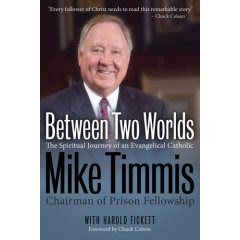
Between Two Worlds

This is a really long chapter and it doesn't do the book justice at all. I have long been a proponent of unity. Mike Timmis is certainly more qualified and has been doing it longer than I have. It is a tremendous book and well worth the money.
Introducing the new blog alliance devoted to Non~Fiction books, Non~FIRST, a component of Fiction in Rather Short Takes (FIRST). (Join our alliance! Click the button!) This is our very first blog tour. Normally, we will post every 15th day of every month, featuring an author and his/her latest book's FIRST chapter!
NavPress (February 2008)
ABOUT THE AUTHOR:
Mike Timmis had it all.How does a kid from working-class Detroit become an international ambassador for Christ? And what motivated an evangelical-based ministry to choose this Catholic as its chairman? Mike Timmis’s inspiring life as a Catholic and evangelical leader reveals how our unity in Christ transcends the two worlds’ differences. From him, we learn how Catholics and evangelicals can go into an alienated world together as ministers of reconciliation and witnesses to God’s salvation and love.
Mike Timmis is a chairman of both Prison Fellowship in America and Prison Fellowship International. He was also a practicing lawyer and businessman. A Roman Catholic, Mike is deeply involved in ministry in his hometown of Detroit as well as projects in Africa and Central and South America. He and his wife, Nancey, are parents of two and grandparents of four.
On January 18, 1991, I was flying in a small two-engine plane in east-central Africa from Burundi to Kenya. Our party had just come from a wonderful meeting with Burundi’s President Pierre Buyoya where we’d shared the gospel with him and a number of cabinet ministers. Still, we were somewhat anxious because the Persian Gulf War had started the previous day. Right then, American fighters were in the air against Iraqi positions.
My wife, Nancy, and my son, Michael Jr., were with me, as well as Gene Dewey, the former second-in-command at the United Nations High Commissioner for Refugees, and Sam Owen, a fellow believer then living in Nairobi. This trip was part of the quiet diplomacy I had undertaken as a member of a group called The Fellowship. We worked on behalf of the poor by raising up Jesus with world leaders, one means of pursuing the ministry of reconciliation that Christ entrusted to His followers.
As we flew over northern Tanzania, the pilot was suddenly issued an order that we were to land immediately. I was sitting close enough to the cockpit to hear the squawking instructions coming over the radio. I quickly assured the pilot that we had the requisite permission to fly over Tanzanian air space. The State Department had issued an order to American citizens to stay clear of Tanzania, an Iraq ally, so I made sure—or thought I had—that we had permission to fly over Tanzania en route to Kenya. The pilot relayed my protest to the Tanzanians.
“No, you do not have permission!” came the reply. “You must land immediately, or we will force you down.”
We landed at the small city airport of Mwanza. As we stepped down onto the tarmac, a military jeep pulled up. A cadre of officials and police officers met us and immediately arrested the pilot and impounded the plane.
Their leader also demanded our passports. I was reluctant to give these up, because no matter what alternative flight arrangements we might be able to make, we would be stranded without passports. Because I had requested—and been granted—permission to fly over Tanzania, our detention was making me angry. (Later I found out that the flight service we were using had previously flouted Tanzanian regulations and had again on this occasion.) Because my family was with me, I restrained my temper. My jaw clenched, I reluctantly handed over my passport.
We were allowed to find our own accommodations in Mwanza, and we found a car that took us to the New Hotel Mwanza. I would hate to have seen the old Hotel Mwanza. We were the hotel’s only guests, and for good reason. The first thing I did was check under the bed for bugs and rats.
As we caught our breath in our hotel room, I asked Nancy if she was afraid. “No, I’m not afraid,” she said. “You are with me, our son is with us, and God is with us.”
Even though we were stranded in an African backwater, I felt the same. I knew I was where God wanted us to be and felt—as I always have in my travels to what are now 114 nations—that God was going before me. In my many years of traveling on various missions, I’ve always felt protected by the special anointing that comes with God’s commission. Lost geographically, I was still at home spiritually, and for that reason at peace.
Our party of five met for dinner in the hotel’s restaurant. My family is Catholic, and Gene Dewey and Sam Owen were evangelicals, but the unity we knew in the Lord sustained us, even when the dinner turned out to be rancid.
After a little while, the hotel manager, having no other guests, joined us at our table. This made way for the night’s entertainment. Four strapping young men in red overalls—the kind gas station attendants used to wear—came out, and with lamplight smiles launched into song:
My baaaaah-dy lies over the ocean,
My baaaaah-dy lies over the sea. . . .
Yes, they said “body” not “bonnie,” and since we all felt an ocean away from home, the song struck us as hilarious. Then the quartet followed with “Home on the Range,” and we nearly wept from laughing. We clapped and cheered, showing our appreciation to the young men. They had done us more good than they could possibly have known.
I spent the next day searching for transportation out of Mwanza. The others paid special attention to BBC radio reports on the progress of the war.
Within thirty-six hours, a plane flew in for us from Nairobi. We went out to the airport to meet it, eager to hightail it out of there. But when we arrived at the airport, no one seemed inclined to return our passports. Thankfully, Gene Dewey was already anticipating this. Because of his time with the United Nations, Gene had the most experience in dealing with government officials. He had also been a colonel in Vietnam and had a knack for being cool and fiercely determined at the same time. I kept asking him when he thought we’d get our passports back—and how. “Mike, don’t worry about it,” he’d say.
As we were walking out to the plane, bags in hand, with a couple of Tanzanian officials to the rear in escort, I looked over at Gene and said as forcefully as I could under my breath, “Gene, our passports!”
“Not now, Mike,” he replied quietly but just as forcefully. “Just don’t worry about it. Keep walking.”
It wasn’t until we were in the air that Gene unbuttoned his shirt and fished out all our passports.
“How did you get those?” I asked.
“I came out to the airport last night,” he said. “I broke into the office and took them. If you had kept talking, they might have found out!”
Gene’s street smarts reminded me of how I’d grown up and made my way. I asked myself, “How did I get here? How did a kid from the rough and gritty streets of Detroit end up on a trip to see international dignitaries? How could a guy born and raised Catholic go on a mission representing a largely evangelical organization?”
I’ve had many amazing, frightening, and heart-rending experiences as I’ve traveled the world in service to the King of kings. And one thing I can say for certain: when you entrust yourself completely to God and make yourself available to Him, you’re in for an adventure.
***
“Mike, the only way you can be ensured of success,” my father once told me, “is if you take it into your own hands and go into the professions.” I was an Irish Catholic kid from the battling West Side of Detroit, the youngest of five children, keen on finding my own place in the world.
My father remains the strongest man I think I’ve ever known, with enormous hands, a powerful physique, and an energy that stayed with him into his nineties. I saw him lift a car out of a ditch when he was in his sixties, although he did injure his back. As young men, he and his brother Brian went out to western Canada, where they took jobs as real-live cowboys, breaking horses. Brian stayed, became a Mounty in Regina, Saskatchewan, and played professional football there. My dad returned to Ottawa and played wingback for the Ottawa Roughriders.1 There he met an Irish girl who was both passionate and practical, and he had the good sense to ask for her hand.
My parents emigrated from Canada to Detroit in 1930, at the beginning of the Great Depression. My mother’s uncle had moved there earlier from Ottawa and convinced my parents that the Motor City was one of the last places in North America where a man could find regular employment. Our relatives soon moved back to Ottawa, but my father and mother stayed, and Dad hired on with the city as a bus driver. He eventually worked his way up through the civil service system and retired as a bus station manager.
Most of his working life turned out to be far different from the spirited and reckless days as a cowboy and pro football player. I was the last of five children, separated in age by twelve years from my eldest sibling, Margaret Claire. My parents were well into their forties when I was born in 1939, and so I never knew my father as a young man. Or a particularly happy man—not at least until much later in his life when, in retirement, he was able to live on a farm and keep horses.
While I was growing up, I remember my dad collapsing into his chair at the end of his long days. He’d take up one of Luke Short’s westerns—he probably read ten times every novel the man had ever written. I can’t say for certain whether he ever graduated from high school. I know he served in the Canadian forces in World War I, beginning in 1914 at seventeen. And since he was born in 1897, so he might have left for the war before graduating.
We were a serious family, always working or studying or going to St. Brigid’s, our local Catholic parish. Our faith was a great comfort to both my father and mother, but it was also a cause of concern as to the children’s futures. My father felt that Irish Catholics were discriminated against, so he insisted that my brothers and I become doctors.
At the time, all of Detroit was divided into ethnic neighborhoods of Poles, Eastern European Jews, Irish, Germans, Italians, and so on. We lived in an Irish Catholic enclave. The houses stood one against the other on forty-foot lots, with bay windows to one side of half porches. The weave of that community was very close-knit. As a ten year-old, I once cursed on a playground a block from home and received a slap for it when I came in ten minutes later for supper. A neighbor had heard what I said and promptly telephoned my mother.
But such strictures helped keep the city a safe and open place where I was free to roam. Not only did we not lock our front door, but I don’t remember there being a key. From the age of eight or nine, I could walk down to the local candy store and then hop busses down to Woodward Avenue, where Hudson’s, the giant department store, mounted huge Christmas window displays.
At the same time, the neighborhood had its own pugnacious code: You stood up to a fight or you simply couldn’t live there. Taking a beating was far better than being constantly harassed, so I did a lot of fighting as a kid. I can remember coming home from school one winter day. My sister had taken the bus home from college, and one of the neighborhood bullies, whom I’ll call Larry, had thrown an “ice ball” that hit her in the face.
My dad said to me, “Take care of him.”
Larry’s reputation as a bully was well earned, and I said, “Dad, this guy is going to kill me!”
“I don’t care,” Dad replied sternly. “You go out and you take care of him—now!”
Anger with my father for ordering this confrontation drove me out into the streets. When I caught sight of Larry, I ran after him, yelling at him vehemently. He hardly knew what hit him! I was so angry with Dad that I beat the living daylights out of the kid. I had him down on his back by the curb, where water was running from the snowmelt, and I whaled on him.
My father may have been so concerned about prejudice against Catholics because he’d had to overcome that obstacle when he started courting my mother. My dad’s family was high-church Anglican. He converted when he married my mother, which wasn’t much of a stretch, since high-church Anglicans worship in a liturgical style as close to Catholicism as Protestantism gets. Still, crossing to Rome was always an issue, especially at a time when Help Wanted signs included the postscript “No Irish Need Apply.”
My mother’s family, the O’Reillys, originally from County Clare, were Irish Catholics to the core. My mother was a petite woman, not more than five feet tall. In appearance, she was what they call dark Irish, with mahogany and cherry wood strands in her hair and a flame in her light-blue eyes. The O’Reillys, who owned brickyards, were far more well-to-do than my dad’s family.
The pictures of my mother that I keep close by are candid shots; they show her as a young woman with the new bob of short hair that came in with the 1920s, striking a jaunty attitude. I can imagine this young Irish lass losing her head over my powerful, handsome father.
She was told never to have children because of a weak heart, and then she went and had five. Better educated than my dad, she had been to what was called a “normal school,” or teacher’s college. I would guess that many of our family’s intellectual and creative gifts came through my mother. My brother Gerry, who the family called Sonny, would go on to be a famous cardiologist; Hilary, an outstanding surgeon; and both my sisters, Margaret Claire and Agnes Cecile, went to college and had marriages and careers that took them well up the economic ladder.
Once married, my mother never worked outside the home but gave herself completely and utterly to her husband and children. That didn’t keep her from having a sharp tongue, or so my sisters claim; I never was cut deeply enough to remember her that way. It was not so much that I was the “baby” of the family, but that my mother’s health was in serious decline by the time I reached early adolescence. She was too exhausted to protest against much of anything by then.
Both my father and my mother led our family in practicing our Catholic faith. In fact, when I think of my religious formation, I remember the faith as a distinctly family affair. Our devotions as a family made a great impression on me. We devoted the month of May to praying with Mary—not to Mary—to her son, Jesus.
Every Sunday night, my whole family knelt down at seven o’clock and prayed for the conversion of Russia. My brothers Sonny and Hilary began to protest against the practice when they became busy medical students, but even then my parents insisted that the time be set aside.
On Tuesday evenings, we went to St. Brigid’s for devotions, praying the rosary, making novenas, or listening as a “mission” was preached—what evangelical Protestants know as a revival service. These devotions largely disappeared from the Catholic Church after Vatican II in the early sixties and only now are being reinstated. The piety they encouraged came to be regarded as old-fashioned. Through these devotions, the Catholics of my parents’ generation—and generations before them—experienced the Catholic faith as intensely personal. The devotions also encouraged them to recognize their faith as God’s work in their lives. I experienced enough of this to clearly understand that my salvation was dependent on the completed work of Christ—not on my own righteousness. There was never a time when I was under the misimpression that my “works” would get me into heaven.
I attended the local parish school, St. Brigid’s, where I was prepared for First Communion and Confirmation by the sisters who taught us. My first confession at the age of six saw me truly penitent, if confused. There were no secrets in our Irish Catholic family, and everyone wanted to know to what I had confessed. I told my brothers and sisters that I had admitted to adultery about a hundred times.
“You did?” they asked. “What did you mean?”
“That I picked my nose!”
I’m sure the priest about fell off the chair as he smothered his laughter.
Still, my First Communion was a memorable experience at which I received a child’s prayer book—one that I only recently parted with when I gave it to my granddaughter on the occasion of her First Communion. It meant that much to me. Even as a young child, I took the privilege of being invited into communion with God very seriously. I think most children do, because they understand intuitively what it means to be God’s child.
At St. Brigid’s, we were schooled in the Baltimore Catechism, so when I was confirmed in the Catholic faith in fifth grade, I knew all the right answers to the classic questions. Who made us? Who is God? Why did God make us? In retrospect, I wish I had understood and experienced these rites of passage more in terms of an evolving relationship with Christ rather than as childhood milestones. Confirmation comes later now, when a child is about twelve or thirteen, which I think is good; older children are better equipped to understand Confirmation as a personal commitment. At the same time, I’ve always been glad that the rudiments of the faith were drilled into me. This provided me with certainty and hope at many difficult times in my life, especially in the crises that crouched around the next corner.
***
My peaceful, happy childhood was disturbed by illness when I was about twelve years old. I returned home from a Boy Scout retreat with pneumonia and what the doctors suspected was rheumatic fever. I was sicker than I probably knew for a number of months and missed virtually all of eighth grade. After I regained my strength the first time, I had a relapse, and our doctor became worried about the condition of my heart. He ordered that I not participate in any sports. When I entered U of D High (University of Detroit High School, now called University of Detroit Jesuit High School and Academy), I was allowed to climb the stairs to the freshman and sophomore classrooms only once a day.
This was especially frustrating because I’d always had amazing stamina; I really didn’t pay much attention to the doctors’ orders except when under the direct supervision of my parents or the school. Still, the inactivity led to weight gain, and I became a pudgy kid, which I hated. What’s more, the physical isolation my illness brought with it became an emotional isolation. Like my father, I took refuge in books, becoming a voracious reader. I liked history and novels especially, and, as I often had trouble sleeping, I would grab a book and read long into the night.
My mother worried over me because of my health, of course, and that added to my brothers’ and sisters’ complaints that I was being spoiled. One time, Hilary was especially upset with me. We were arguing, and my mother admonished him to lay off me.
“He’s turning into a spoiled jerk,” Hilary insisted.
“Look at me,” she replied. “You’ve had a mother. He’s not going to have a mother. Leave him alone.”
Anyone could see by her pallor that her health was in decline. Indeed, her heart condition was growing rapidly worse. I vividly remember the night she died, April 11, 1955. It was Easter night. Sonny, a senior, and Hilary, a junior in medical school, were attending to her. They were talking on the phone to her doctor, their voices rising and becoming more strained as they followed his instructions with little effect. I came into her room while this was going on and heard Sonny yell into the phone, “I’ve already given her a shot of adrenaline and it’s not working!”
I looked at her, propped up on two pillows. I asked her, “Mama, what’s wrong?”
She was always a very prayerful woman, and she chose to answer in the only way she could. She took out her rosary from between the pillows and with her thumb held up the crucifix to me. That was the last thing she did. I was fifteen years old.
My father had always revered and worshiped my mother. He mourned her loss terribly. It so happened, as well, that her death came as the nest was about to empty. Long before my mother’s final illness, Margaret Claire and Sonny each had been planning their weddings. Both were married and gone within two months of my mother’s death. Hilary left for the University of Pennsylvania to begin his residency in surgery. The following year, Agnes Cecile, married as well.
My father never had many friends. He didn’t go out with the boys, and he drank hardly at all. For many years, he had lived a life of heroic, if quiet, sacrifice as he devoted himself to his wife and children. Our at-home family of seven had quickly dwindled to two.
Within a year after my mother’s death, my father and I fell into a grim Sunday regimen. We would go to Mass at ten o’clock, then drive to the cemetery, where my father would weep so uncontrollably that I would have to drive us home.
I was very lonely, but also very religious. We had Mass every day at U of D High, and that was important to me. I thought long and hard about becoming a priest.
Every day, when school let out at 2:35, I would stop by the chapel once more. I’d sit there and talk to my mother and pray, then hitchhike or take the bus home to an empty house, which was difficult.
I was fortunate to have my sisters and brothers and good friends to lean on. They made up much of what was lacking at home. Margaret Claire became like a second mom; as the eldest she had always nurtured me. When she married two months after my mother died, she and her husband, Russ Hastings, rented a small apartment only two or three miles from where we lived. She was extremely good to me, providing a desperately needed last dose of mothering.
I would often ride over to their apartment on my bike. Margaret Claire taught me manners, particularly how to behave around young women—a subject of increasing interest. She also taught me how to dance. She would put “Peg of My Heart” and the other romantic ballads of the mid-fifties on her old phonograph and show me how to glide with my partner around the dance floor. She’d let me cadge a cigarette from her pack now and again, but “only one,” she’d say, keeping to a motherly moderation.
Margaret Claire had worked as an executive secretary before marriage and would later raise seven children of her own. Russ was a CPA and became comptroller of Dodge Truck. They were the first among my family members to enter a whole new socioeconomic class.
Within eighteen months of my mother’s death, I underwent a transformation that was partly physical, certainly emotional, and had unexpected spiritual extensions. I began to realize that my brothers and sisters were off making their own lives. I felt that I was completely on my own and that I would rise or fall on my own strength. My father’s admonition that I take my success into my own hands became an implacable necessity. At the deepest level, I decided that I was going to live my life and not be a victim. I wasn’t going to feel sorry for myself. I was going to carve out my own life, whatever it took. I began hardening myself and maturing swiftly.
Between my junior and senior years of high school, I determined not to be fat anymore. I fasted, eating sparingly, all summer while working as a house painter in the sticky Detroit heat. My last growth spurt hit at the same time, taking me over the six-foot mark. I lost thirty pounds and grew about four inches. When I came back to school for my senior year, people hardly recognized me. The following summer, when I was working as a scaffold painter with a crew of older men, they took to calling me “Six O’clock,” because I was as thin and straight as clock hands at six o’clock.
Losing so much weight renewed my confidence and helped me reconnect with the tremendous stamina and energy I’d known as a child. I felt powerful and ready to meet life’s demands—on my own terms.
The Perfect Life
Robin Hatcher is not at her best in her latest novel. The storyline is excellent but it doesn't follow through with the promise in the set-up. Enjoyable, but not her best.Katherine Clarkson has the perfect life. Married to Brad, a loving and handsome husband, respected in their church and the community. Two grown daughters on the verge of starting families of their own. A thriving ministry. Good friends. A comfortable life.She has it all--until the day a reporter appears with shocking allegations. Splashed across the local news are accusations of Brad's financial impropriety at his foundation and worse, an affair with a former employee. Without warning, Katherine's marriage is shattered and her family torn apart. The reassuring words she's spoken to many brokenhearted women over the years offer little comfort now.
Only Uni
Isn't she adorable? This is Camy Tang who is the author of Sushi For One and her latest Only Uni. This will be the subject of The FIRST post on Wednesday this week. But, I'm giving you a sneak peak.
I loved her first one and I wrote that you could depend on getting a good read just from her name. I was absolutely correct. Camy's second book Only Uni is outstandingly fun.
This is the second in the Sushi Series.
There are 4 cousins who belong to a blended Japanese and Chinese family. We read about Lex the volleyball jock in the first one. Only Uni is about Trish, the flirt, who got put in her place by Lex's flame from the first book. Does this begin to sound like an Asian Soap Opera? Who knew Korean day time drama was so... well... dramatic?

Trish is trying to find her way back to her wonderful relationship with God. She stubs her toes and scrapes her knees a couple of times before she gets wrapped in His loving arms. Trish comes up with three rules from First and Second Corinthians: 1) Stop looking at guys, 2) Only date Christians, and 3) Persevere in hardship by relying on God. If she follows them, God will restore her life to the way it was before her mistakes. If she can somehow regain her chastity, she won’t feel as dirty and unworthy as she does now. They’re only three rules. How hard can it be?
A surprising story in that it is so much like real life. You can almost hear yourself in Trish's musings. It is fascinating to learn about traditions of the Japanese and Chinese. Plus, it is so refreshing to see how one young woman reflects the times, yet doggedly fights her way past the lure of momentary pleasure into the pure pleasure of living for her Savior.
I loved this book. It is well worth the money and it is a keeper. You'll probably want to read the whole series again when you've collected them all. Go to Camy's website for much more of her witty writing and some short stories.
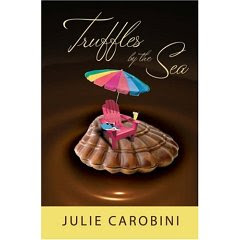
Truffles by the Sea
I was surprised that the protagonist was Latino... or was she Italian? I'm not sure, because I couldn't tell from the name Flores or from the word si or from some of the other clues, except from the author's name, Carobini. I didn't like that, because I really like to know the whole setting by the end of the first chapter if the author is going to throw in foreign words. It's only fair.
Another thing is that present tense monsterous point of view. It is okay to use to make a point, but it is incredibly tiresome to read in bulk, seriously.
That being said, this is a good storyline and the book delievers what it promises. That is a good finish line for any novel.
Gaby Flores is Drama Queen in action. She, evidently, has a penchant for attracting the wrong type of guy. She puts her whole heart into... well, I won't give it all away. Let's just say that she has an extremly attractive landlord, a mechanic with a chocolate gaze who comes to the rescue like a knight on his white steed. Also in this pot is her friend Bri and her husband, a nosy neighbor and a friendly sea lion. Add to that a lovely beach location and you've got a pretty good read. Don't forget the sunscreen.
Julie: To celebrate my upcoming CFBA tour March 5-7, I'll be giving away a copy of Truffles by the Sea AND and a 1/2 lb. box of yummy truffles to three of your readers.All they need to do is drop by my blog http://juliecarobini.blogspot.com/ during the tour and leave a comment and a way to contact them if they win!
The blog tour is today through Friday, March 7.
My Name Is Russel Fink and interview with author Mike Snyder
No... this isn't Russel Fink. This is Mike Snyder the author of the book.
Isn't he cute?
There is one thing about Mike Snyder and that is he is extremely unusual. His wit is a bit on the weird side, but that does not make it any less hilarious. He's been working hard on this novel for a long time. I remember the day I first heard about this character named Russell Fink. It was a short story and it was such a striking story it stayed with me for the past two years.

That story was about Russell Fink, and his fiancé was a lot more whacky, and not as likeable. Russell is a copier saleman who is just going through the motions and staying just ahead of the pink slip because his boss loves him as much as his boss's son hates him.
And who murdered his dog? Why did he punch out his boss? Why is his girl climb up a tree and for that matter why did Russell climb up a tree? Oh... and there are many more questions that you'll have to read the book to find out the answers. But...
It just so happens that I sat down with Mike and got him to answer some questions. I'll share them with you right now.
Mike – I noticed at the bottom of one of your short stories a thought process on how you developed your story. I also noticed (and you mentioned it, too) that "My Name Is Russell Fink" has some overtones and flavors – oh, all right – looks a lot like some of your short stories, or rather, three of your short stories are imbedded in your novel. What role did those stories play in how you built your plot line?
I love reading and writing short stories. It’s a different discipline than novel writing. A short story requires precision and brevity. At the same time, there’s more flexibility when it comes to form or structure or plot (Or in my case, lack of plot? The plot in MNiRF was not so much “built” as it was “tripped over”). I think what I’m going for in a short story is an emotional snapshot. For instance, the “sadder” parts of Russell Fink grew out of a much darker story about an entirely different character. Also, shorter works are also a great way to see if the story/character I’m working on has any kind of staying power.
Did you ever chase a rabbit while writing and have to scratch a chapter? If so, what happened?
Thankfully my editor did most of the chapter-scratching for me. And I’m really glad he did. My ratio of seat-of-your-pants writing vs. outlining used to be ninety-nine to one. Now I’m about 75/25. I do love the freedom and surprise and spontaneity of making things up as I go along. But it’s easy to write yourself into a corner without an outline. And I must admit I do this routinely. It’s time-consuming and frustrating, but I believe it’s a healthy part of the process. Still…sometimes a throwaway scene will have at least one great metaphor or one juicy paragraph that crystallizes some vital part of a character that you might have missed without writing the scene that got cut. I choose to believe that there’s no such thing as wasted writing.
Did Russell and his dad finally become friends or do they still have a lot of work to do in their relationship?
Hah, I’m not sure I have a good answer for this one. The most honest answer I can give you is, “I don’t really know.” But whether or not they actually become friends one day, they’ll still have a lot of work to do. And that’s okay. We’re all a bit of a mess. Russell and his father’s dysfunction just happened to be played out between the covers of a book.
And not to get too weird here, but I look at stories the same way I look at comedy. I’ve been told a time or two that I’m funny (see question #5). And I suppose there’s some truth to that. But I think it has more to do with training your senses to pick up on humor. I don’t create funny things; rather I observe them, then point them out to others. Most ‘funny people’ are merely conduits who’ve honed their timing and delivery, and are willing to risk not being funny.
It’s the same with stories. The reason I can’t be sure about what happens to the characters after the last page is because I never really got that far. I sort of went along for the ride, transcribed as much as I could, and hoped it would all turn out okay. So it’s hard for me to claim too much ownership of the actual story or predict what happens after The End.
Which character was the most fun to write and why?
Wow, that’s tough. And my easy ‘cop-out’ answer is: “Whichever one I was writing at the time.”
I really did enjoy writing every single character. I love them all. But if I had to pick only one, I guess it would have to be Dan. I’m sure there will be readers who deem him unbelievable, but I feel like I really know Dan. Although they have very little in common, he sort of reminds me of the roommate in the film Notting Hill, annoying but lovable.
Dan actually was fun to read, too. Sort of a surprising character (and vocation :) Did you ever just crack yourself up and laugh out loud while writing? Which part was it?
I think I remember laughing a few times, probably at Russell’s Battle of Jericho chant or the scene where he describes the doctor’s office. But truthfully, my emotions ran hotter in the other direction. I probably teared up twice as often as I laughed aloud. And that’s not an altogether bad thing. But there’s nothing I like more than amusing people. So just the fact that you asked the question makes me all warm and fuzzy. Okay, maybe just warm…I did shave today.
Sadder parts? Mike there weren't that many, it was such an upbeat book. Which sad parts got to you?
The sad parts (if I can remember them all) were mostly about Katie. I think there was a really tender dream scene that got cut as well. And then Gramps' funeral was really an emotional scene to write. Again that got pared way back, but it will be interesting to read it all again and see if those parts hit me the same way?
What was the best advice ever given you concerning your writing career?
Write every day, or close to it. And if you don’t love what you’re writing, don’t bother. Oh, and read, read, read! Read what you love and read over your head. Then read some more.
There’s other great advice out there, for sure. But I stand by those. I’ll even take it a step further and suggest that if you find yourself writing something you don’t love, then you should stop and write something else. I have abandoned one novel after sixty-five thousand words and another after eighty-five thousand. I have no idea if they were any good or not, but when I fell out of love with them there was no point going on. (NOTE: this should only apply to writing or inanimate objects—pets and family and friends are not to be so easily discarded!)
What tips do you have to offer aspiring writers?
For starters, I would ditto my last answer. But that would be too easy. So I’ll go with this one instead—don’t worry so much. Not about the rules or getting published or whether everyone likes your writing or whether you’re any good or not…and especially don’t worry so much about the results. Just read a lot, pray a lot, and write a lot.
I’m not advocating a bury-your-head-in-the-sandbox strategy, not by a long shot. We should all track our progress and make sure we’re getting better. And getting published is a great goal to have, and as such, there will be a few worrisome details to deal with. But please keep all that to a minimum. The single best thing any writer can to is to keep on writing and never lose the joy in the process. Those are things we can control.
What did you learn about God while you were writing this story? How has that impacted your life?
I think I got more reminders than any sort of new revelation. I was reminded that God has a sense of humor, that He loves stories, that no matter what our past is like or whatever batch of dysfunction or neuroses we throw at Him…that He will do what He does. He loves and redeems the lost and lonely and broken-hearted. Stories are a really good way to remember those truths.
I just love it when that happens. You turn a corner and suddenly there God is. It makes me smile every time. Is there a question that you'd like to answer that I didn't ask? Be brilliant and give me a good one :D
That’s hard…and a wee bit tricky on your part too! Let’s see…
Question: As far as the themes in the novel, were those thought out ahead of time and worked into the manuscript? Or not?
Answer: Not.
It’s pretty funny, actually. I’m reading Russell Fink again now (just got my first copy in the mail this past Friday!) and am seeing things I didn’t notice the first ten times I wrote it. To me it’s just further proof that God is the ultimate writer. His very long love letter to His children is read every day by millions and millions of people. But there seems to be no end to the “new” revelation He pours out on us through His words. (And for the record, I did NOT just compare my writing to God’s. For one thing, He’s been at this a lot longer than me. Plus, He’s got that whole I’m-God-and-You’re-Not thing in his favor too.) By His ultimate design, the written word speaks far beyond what’s actually on the page or what was in the brain of the writer at the time. And that’s a good thing too.
Thank you for allowing me to come over and play on your blog, Gina, It was a treat. And thank you to anyone who read this far.
Abandonded Identity
Abandonded Identity is a MUST read. This book is captivating from the very first word... of course, if you like romances.I do not believe in love at first sight, but I do believe that our subconscious recognizes and latches on to subtle qualities which draw us to some people and repel other people. I also believe that we can be attracted to certain people over and above the superficial.
Happy New Year! It is January 1st, time for the FIRST Day Blog Tour! (Join our alliance! Click the button!) The FIRST day of every month we will feature an author and his/her latest book's FIRST chapter!
This month's feature author is:
and her book:
Abandoned Identity
Evergreen Press (AL) (August 1, 2007)
ABOUT THE AUTHOR:
Hooray! Tamara is one of our very own FIRST members!She resides with her husband, Walter, and their children, John, Christopher, and Jennifer, at Hume Lake Christian Camps in the Sequoia National Forest. They have served on full-time staff and ministered at Hume for 13 years.
Tamara manages one of the retail stores at Hume Lake, which serves thousands of kids visiting the conference center on a daily basis.
Not only does she write, she is also an avid reader and enjoys other hobbies such as scrapbooking, designing greeting cards and invitations, and enjoying God's creation from her from porch.
AND NOW...THE FIRST CHAPTER:

The young, blond woman stepped off the elevator, rushed past the receptionist, and quickly headed down the hallway.
“Jennifer, Mr. Lynch is looking for you,” Doris called after her.
Jennifer didn’t stop to acknowledge the message. She didn’t have time. She could hear the warning in Doris’ tone. Mr. Lynch was looking for her, knowing she was late returning from lunch. This could very well be her last day at Weissler and Schuler.
She glanced at her watch as she threaded her way through the multitude of workstations. She moved as quickly as she could, even though she knew her efforts were probably for nothing—after all, late was late. He would assume she had done it on purpose and would make good on his threat from the previous week. Lynch had given her two weeks to change her attitude or she would be fired.
She hurried past his office door, hoping against hope that she would be able to slip by without being noticed. A sideways glance told her otherwise. She continued towards her own office, knowing he would be quick on her heels. She had struggled all morning, trying to do her work, trying to keep it together, but with the way she was feeling, her resolve was beginning to crumble. She’d only had enough time to slip off her jacket before she heard his booming voice in the hallway.
“Ms. Patterson, you of all people should not be abusing time restrictions. A one-hour lunch is a one-hour lunch, not an hour and 25 minutes,” he scolded her loud enough so everyone could hear him as he made his way down the hall toward her office.
Jennifer hung up her coat and purse on the rack behind her door and slumped in the overstuffed sofa that filled her office. She braced herself for the inevitable.
“You knew we needed to get started on the Yomahama account first thing after lunch,” he said as he entered her office and firmly shut the door. “Obviously you don’t care about this account as much as you say you do.” He was poised for her counterattack but was surprised instead to hear her soft apology.
“I’m sorry. I thought I could make it home and back again. But with the snow, and the traffic, and the way I’m . . .”
What’s the use explaining, she thought to herself. He doesn’t care. She had just given him the excuse he was looking for. She figured she would be packing up her personal items in less than an hour. She took a deep breath, her eyes focused downward. “I’m sorry. It wasn’t intentional.”
Harrison was taken aback. In the short time he’d known Jennifer, she had never apologized for her actions. Everything she did was intentionally antagonistic toward him. But somehow he sensed a difference in her mood.
“What’s wrong?” he bristled, not really wanting to hear her excuse.
She glanced up at his imposing figure but lowered her eyes to the floor as she spoke. “I tried to kick something all weekend. I guess I’m just not feeling up to par.”
He said nothing, waiting for her to make eye contact with him. She stiffened her back, sighed and said, “It won’t happen again.”
Had she brushed a tear from her cheek? Not possible, he thought to himself. Jennifer Patterson was tough as nails. She would never lower herself to tears in the workplace . . . that was unless she really was ill.
He waited again for her to look up at him, and when she did, he was met with vacant eyes, pallid skin, and beads of sweat that were starting to form on her brow. Just then, the intercom system went off. “Mr. Lynch, Mr. Yomahama is on the line. Shall I put him through to Miss Patterson’s office or your own?”
Obviously Doris knew where to find him because of the scene he had just made. He walked around to the front of Jennifer’s desk and cleared his voice before pushing the intercom button. “I’ll take it in my office, Doris. Give me a minute to get there.”
Lynch gave Jennifer one last stern look and then marched from her office, shutting her door with a little more force than necessary.
She collapsed against the cushions, her strong exterior completely dissolving. She had done everything she could to hold back her tears in his presence, but his quick exit allowed her to unleash the torrent she had been suppressing.
She had never felt this horrible before in her life. She would’ve called in sick if it weren’t for the fact that she knew her job was in jeopardy. It isn’t fair, she thought to herself. I should have Lynch’s job. For the hundredth time Jennifer went over in her mind the scenario that had taken her completely by surprise.
She had been groomed for the director’s position by Meg, long before Meg left to start a family. Jennifer had put in countless hours on different accounts to make sure her and Meg’s statistics had been well researched and presented in a polished manner. She had done the bulk of Meg’s work, along with her own, as Meg progressed into her third trimester. It simply wasn’t fair!
The day corporate brought in Harrison Lynch and announced he would be the new director, instead of her, she was livid. She felt demeaned and unappreciated. Everyone in the office knew she had worked hard for the job and had deserved it. But corporate behaved in their typical chauvinistic manner and took the opportunity to replace Meg with a man instead of another woman. Testosterone was the only asset that Harrison Lynch had that she did not.
While the other women in the office were quick to overlook the injustice of the situation because of Harrison’s availability, good looks, and charismatic personality, she only saw him as a thorn in her side.
She would only be fooling herself if she said she didn’t see his appeal. He was older than she was—the classic tall, dark, and handsome type. His sparkling brown eyes and wavy brown hair gave him a boyish charm, but his stature and muscular body proved him to be anything but boyish. His enigmatic character made him the kind of man that breezed through life with ease, putting the Midas touch on everything he encountered. But the way he clashed with her, rubbing her the wrong way and always trying to put her in her place, made his good looks less appealing.
Jennifer had butt heads with Harrison ever since he had shown up. She was not afraid to speak out against his proposals or the way in which he supplied information to a client. She had caused him more than one embarrassing moment in important meetings with prospective accounts. She upstaged him with what she called “a more efficient way to gather and record information.” She didn’t think it beneath her to use her feminine mystique with a client in order to work on a case that Lynch would’ve preferred to handle by himself. Lynch had put her on the spot on more than one occasion, but somehow she always came out looking professional in front of the clients.
When she had worked with Meg, Jennifer’s desk was out front with everyone else’s. She liked it that way. She enjoyed working in an environment that buzzed with activity. But Lynch changed all that. He made it very clear that Jennifer was his assistant, and he needed her at his personal disposal. And so he had her move her things into the smaller of the two conference rooms.
Giving Jennifer her own office was not a reward but a sentence. She felt he had isolated her on purpose to break her spirit. It had taken the wind out of her sails for a short period, but she decided two could play at that game. She promptly ordered custom office furniture and personalized the space. What he had intended on being a lonely, sterile environment, she had turned into a showplace of warmth and femininity.
She had one-upped him again and gloated in the fact that he could do nothing about it. After all, he was the one that gave her her own office and the freedom to decorate it the way she wanted. The fact that she did it with pastels in a style she knew he disliked (even though she disliked it too) was icing on the cake. Harrison had declared that an office should reflect professionalism not personality and initially insisted she get rid of everything. His request was denied when Mrs. Weissler came in and admired what she had done with the old conference room. With Mrs. Weissler on her side, Jennifer had once again thwarted Lynch’s authority.
Lynch had finally had enough. He called her into his office a week earlier and lowered the boom. “I’m giving you two weeks notice.”
“You’re firing me?” Jennifer was floored. Though she knew that he disliked her as much as she disliked him, he would have to explain to corporate why he was letting such a valuable employee go.
“No, I’m not firing you . . . yet.” He was cool and calm as he sat behind his solid oak desk. “I’m giving you two weeks to change your attitude. I’m tired of the mind games, the flirting with clients, and the way you insist on making proposals before discussing them with me. Weissler and Schuler should present a united front to all our clients, not a sense of division and indecisiveness. You have two weeks to get on board, assume your position as my assistant, and change your ‘I can top that’ attitude. If you choose not to, you will give me no alternative than to let you go.”
Now, it was just a week later, and Jennifer had given Lynch the perfect opportunity to show corporate that she was not the team player that they had assumed her to be. Corporate was breathing down everyone’s neck about the Yomahama account. It meant millions to them if they could seal the deal. If they felt she hadn’t given it her all, they would allow Lynch to have his way, no questions asked.
Jennifer sobbed into the arm of the floral couch that she despised. She thought about all the ways she had tried to make work uncomfortable for Harrison Lynch but knew she had failed. On occasion, he had tried joking with her and having innocuous conversations, but she would have none of it. She wouldn’t accept the olive branch that he tried to extend to her. Now he would have the last laugh, and it would be her own fault.
The door swung open once again. Harrison was poised and ready to battle with her, only to find her hunched over, her head in her hands and tears falling onto her charcoal colored slacks.
He felt uncomfortable finding her in such a vulnerable position. The all-business exterior he had resolved to use with her now took a back seat to the compassionate Harrison that others had seen. He stood for a moment before taking a seat on the couch alongside her and waited for her to gather her composure. It took several minutes before she could speak.
“I know what you’re going to say, so I’ll save you the energy.” She rubbed at her aching brows and sniffled. “You’ll have the files for the Yomahama account on your desk by the end of the day, and I’ll clean out my things. You can do what you want with the furniture. I don’t want it.” She held her head like she was afraid it was going to snap off her neck.
Harrison just sat there, not saying a thing. Jennifer wished he would just leave. She felt defeated and humiliated. He’d gotten his way; he’d won. With the experience she’d gained at Weissler and Schuler, she’d have no problem getting a job elsewhere, so she resolved to give up without a fight. Her only desire right then was to get home before her head exploded.
It seemed like an eternity before he spoke again. “What have you taken for it?”
“What?” She was confused. There was no smugness to his tone. In fact, if she wasn’t mistaken, he actually sounded concerned. She didn’t dare look at him. Just lifting her head would hurt too much.
“Is it a cold or the flu?”
“A cold,” she answered, wondering why he was being so nice. It was a trait she didn’t think he was capable of, at least not with her. He got up and left the room without saying another word.
She glanced at his receding steps, totally confused. She grabbed a tissue from her purse and tried to wipe away the salty tears and runny nose that was moistening her lips. She gently rolled her head back against the couch and sighed heavily, thankful for the solitude. It didn’t last long; within minutes, Harrison was back.
He sat down alongside her, causing her head to sway and a small moan to escape her lips. He handed her a glass that was fizzing, along with several pills. “Here’s something for your headache, a decongestant, and a bi-carbonate. They should do the trick.”
“No thanks,” she said through closed eyes. “I can’t take pills. They knock me out and make my head swim. Besides, I still have too much work to do. I don’t have time to pass out.”
“The way I see it, you’re already wasted. You’re no good to me like this. Take these, and in an hour you’ll feel a lot better. I guarantee it. We’ll work on the Yomahama account then.”
“I should have known you wouldn’t let me die quietly,” Jennifer retorted, looking at the pills he was still holding. “And if I don’t take your concoction?”
“Then I’ll have to assume the Yomahama account isn’t as important to you as I gave you credit for, and I’ll get Jerry to work on it with me instead.”
“Jerry!” She sat up, her head throbbing with disapproval. She slowly lowered herself back to the comfort of the couch, covering her eyes with the palms of her hands. “There’s no way I’m going to let Jerry take all my research and screw it up.”
“Okay, then. I guess you’ll have to do it my way,” he said. “Take these, dim the lights, and allow yourself some sleep. Don’t worry about watching the clock. I’ll come and get you in about an hour.”
Jennifer realized it was no longer a suggestion. Harrison put the pills in her hand and waited for her to drink them down with the bi-carbonate.
She tossed them to the back of her throat and held her breath as she drank the fizzy water. She knew she had to do it in one swig, or it would never stay down. Her shoulders shuddered in protest, and she thought she saw the hint of a smile form on Harrison’s lips. He pressed the button for the automatic shades to cover her office windows and dimmed the lights. “I’ll check on you in an hour.” With that, he closed the door and left her with her thoughts.
What just happened? she thought to herself. He had the perfect opportunity to fire me, and instead he helped me. Jennifer couldn’t concentrate on figuring out the answer to that one. Her head was throbbing so hard, it was making it impossible for her to reason.
She pulled her feet up under her and allowed her head to rest on the padded arm of the couch. An hour’s sleep, then I’ll be able to push through the rest of the day. She drifted off quickly. She was a lightweight when it came to tolerating medicine, and with the mixture she had just taken, she knew that she would finally get some rest.
Harrison walked back to his office and closed the door. He stood before the expansive window and watched the falling snow blanket the Chicago streets. Jumbled emotions crowded his mind. He was afraid that he’d allowed Jennifer’s weakened state to play on his sympathy, but it wasn’t unlike him. He really was a nice guy. It’s just that since he’d arrived at Weissler and Schuler, he and Jennifer had clashed . . . no, more like collided.
He found out soon enough that she had thought she was a lock for his job because of the work she had done with the previous director. He tried to talk to her about it and let her know he understood her disappointment. When he told her he was excited to be working with such a talented analyst, she only stiffened at his attempt at civility. Her spitefulness and malice made her look so unattractive—nothing like the vulnerable woman he had just left in the darkened office. He finally saw in her what some of the men in the office already had seen. She was a lot more appealing when she wasn’t being conniving or manipulative. With her defenses down, he actually found himself drawn to her, but he was wary that would change as soon as she had her strength back.
HARRISON HAD BEEN WORKING TIRELESSLY at his computer when he glanced at his watch. He realized it had been more than an hour since he had left Jennifer in her office. He quietly opened her door and leaned in to see how she was doing. She was curled up on the couch, her face flushed and moist. He moved to her side, leaned down, and carefully placed the back of his hand to her forehead. She was feverish. She stirred under his touch, but her eyes had a difficult time focusing. She looked at Harrison and tried to figure out why she was lying down and why he was hovering over her. She closed her eyes and vaguely remembered being late to work and taking a handful of medicine.
“What time is it?” Her voice was barely above a whisper.
“Almost 3:00 p.m.”
“Oh, my gosh.” She tried sitting up as her head spun out of control. “I’ve got to get working. We have the Yomahama meeting tomorrow. We can’t waste any more time.”
Harrison pressed his hands against her shoulders and gently pushed her back against the couch cushions. “You need to rest. Your body is obviously trying to fight something. You have a fever.”
“We don’t have time for this, Mr. Lynch.”
She again moved to a sitting position. She wiped at the perspiration on her forehead and scooped her long blonde hair up into a handful on top of her head. She started pulling at the pink cashmere sweater she was wearing, bellowing it to get some cool air up against her skin. “I feel like I’m suffocating.”
“That’s the fever.”
Before Harrison realized what she was doing, Jennifer reached for the hem of her sweater and began to pull it over her head.
He turned away and sputtered, “What are you doing?”
“If you have a fever, you’re supposed to keep at least one foot and one shoulder exposed to cool air.”
“Where did you hear that?”
“I’m not sure, but it’s worked before.”
She continued to remove her sweater. Harrison was relieved to see that she was wearing a silky, pink shell underneath the soft sweater. She pulled her black, high heeled boots from her feet and curled up into a fetal position once again.
“You look miserable; you need to go home. This is ridiculous. There’s no way you’re going to be able to get any work done under these conditions,” Harrison added as she tried to get comfortable.
“I’d be fine if my head would just stop pounding, and I wasn’t so hot.”
“Let me call you a cab. You need to go home.”
“No! I can beat this. Let me just rest a little bit longer. If I could just get rid of this headache, I know I could finish our proposal. Please give me another hour.” She was determined to finish what she had started, especially since it could quite possibly be her last account. Harrison was being uncharacteristically nice to her at the moment, but if the Yomahama meeting didn’t go well, she knew she would be the proverbial scapegoat.
Harrison stood with his arms firmly crossed against his chest and doubt in his eyes. He knew from past experience there was no sense arguing with her. Of course, there was nothing that said he was obligated to wake her up either.
“Fine, I’ll see you in about an hour.” He left her office with no intention of disturbing her again. If she had the strength to wake up, she would have to do it on her own.
Although Harrison knew he needed to spend every minute on the Yomahama proposal, he found himself thinking about Jennifer. Why hadn’t he noticed her crystal blue eyes or the delicate curve of her jaw before? Maybe because whenever he talked to her, her eyes were glaring and her jaw was set.
He wandered back into Jennifer’s office around 4:30 p.m. He watched her as she slept. Her breathing was even and her complexion no longer looked flush. His eyes followed the tip of her chin to where it rested near her exposed shoulder. He felt his thoughts wandering in a direction that was far from work related. He had always been cautious to keep his professional life separate from his personal life, but somehow seeing Jennifer in such a vulnerable state also exposed a side of her that was quite beautiful.
He left her office and drifted down the hall. People were beginning to shut down their computers and straighten up their workstations. The talk was all about the snow that had continued to fall throughout the day. The weather report was predicting another foot before morning. Harrison waved goodnight to them as they left and headed back to his office.
Doris followed him down the hall, worry etched on her kind face.
“Mr. Lynch, I’m concerned about Miss Patterson. I know she was awfully sick this morning when she came in, and she didn’t look any better when she returned from lunch. I haven’t seen her since you . . . well, since you spoke with her this afternoon.”
Harrison knew what Doris was alluding to. The way he had barked at Jennifer when she returned from lunch had obviously been heard throughout the office.
“I gave her some medicine earlier today, and it made her pretty sleepy. That’s why you haven’t seen her.”
“Will she be okay to drive herself home? The road conditions have gotten pretty bad.”
“Don’t worry, Doris, I’ll make sure she’s okay before she leaves.”
“Okay, I was just concerned. She really is a sweet girl; she just comes off a bit harsh sometimes.”
“Harsh? That’s an understatement!”
Doris just smiled. “Well, good night, Mr. Lynch.”
“Good night, Doris, and thank you for your concern.”
What Lies Within
There are no words that accurately describe this book. What Karen Ball has put together is a smooth read that is predictable, but a good kind of predictable. If it had gone any other way, I would have been mad.In places it is very gripping. In places it is very sweet. I think it is a bit too wordy and in someplaces it bogs down. I just skipped over those and kept reading.
This is a Christian fiction book that actually brings in the Faith Factor. That merits a star all by itself. I give it three stars.
Kyla Justice has arrived. Her company, Justice Construction, is one of the most critically acclaimed, commercially successful companies in the Pacific Northwest. And yet, something is missing. Not until she’s called on to build a center for inner-city kids does she realize what it is: her sense of purpose. Now nothing can stop her, not the low budget, not supply problems, not gang opposition, not her boyfriend’s suggestion that she sell her business and marry him–and most especially not that disagreeable Rafael Murphy.
Rafe Murphy understands battle. Wounded in action, this Force Recon Marine carries the scars–and the nightmares–to prove it. Though he can’t fight overseas any longer, he’s found his place as a warrior in the civilian world. So he soldiers on, trusting that one of these days, God will reveal to him why Rafe survived the ambush in Iraq. That day has arrived.
Kyla and Rafe both discover that determination alone won’t carry them through danger and challenges. When gang violence threatens their very foundations, there’s only one way to survive: rely on each other, be real–and surrender to God. In other words, risk everything…
Nobody

Creston Mapes has created a truly unique winner.
There is a newspaper reporter who has the night shift and hears on the scanner something about a shooting. He heads out to the scene of the crime and there are no cops, no ambulances, Nobody is there. Just an old bum that smells like soap who has been shot. Just an old homeless guy... a nobody.
Not on your life!
This is a truly wonderful read. It has some interesting twists and turns and some characters that probably really do live in Las Vegas. It is not an edge of your seat nail-biter. It has some exciting moments, but not like a roller coaster. That does not at all detract from the book, though. Mapes has a flair for snaring a character's essence and that makes a huge difference. You actually wind up caring what happens to the characters. And the best character of the book is the "old homeless guy" who every one thinks is a Nobody.
The story takes place in Las Vegas. It is very accruate in locale. The protag is a newspaper reporter, and that part of the story is not accurate... but, only someone who's actually been a reporter would catch those mistakes so don't let that stop you from grabbing up this book. It really is worth the money. Go buy it!
Now for a head's up. This is totally different than another book that will be featured here on FIRST in November. That book is called Nobody Hollywood. Do not get them confused. Mapes' "Nobody" is the one to buy.
Island Inferno
Rarely have I enjoyed a book so much as this one. It is Rip-roaring, edge-of-your-seat, nail-biting suspense. And there wasn't one single foul word in the whole book. Chuck Holton is a Wowser writer.It takes a real man to pray and to admit he needs God to be in control.
How many men out there are still struggling with being in control?
I read this in two sittings, only because I had to go to work this morning and I was late, because I was so late going to bed. Choose a different time to read this book than Sunday afternoon. You won't want to put it down. I promise.
What are you still sitting there reading this for? Go get the book! Click on the link above and buy the book. You won't regret it.
You want to know what it's about? Sigh...
This fellow is a special ops guy... did I tell you that this is the second book of a trilogy? Anyway, the special ops guy and his team must track down this liquid bomb stuff called ITEB. When it combines with oxygen, it explodes. (Which is why so many water bottles were conficated by the airlines--did anyone but me wonder about that?)
It's a boy meets girl story only this guy literally falls into her lap.
It's a God taking control story...I do not believe in coincidences, I'm reading a book called "God Winks" which is about that. At one point in the story, I was thinking, that is just too far to stretch believability when I slapped my forehead like "Wow, skip the V-8, it's God at work without the author coming out and saying, "Hey, stupido, God is at work here performing miracles."
It's about not being ashamed of your faith.
It's about real men and how they deal with God. (Great insight, girls!)
It's about a beautiful, but deadly island off the coast of Panama.
Warm, tropical breezes, warm sea water, paradise island, what could go wrong?
Everything! Get the book.
Diva Nash Vegas

I give this book 2.5 stars. I do understand that nonChristians do not live Christian lives. I also understand that people who need Jesus have to meet Him where they are standing. I love stories like that.
Telling a story in present tense, as if it is happening as I read it -- like a movie script -- is okay for a chapter or two, but not all the way through the book. Short sentences are super as exclamation points, but too many leave me breathless and make me tired.
This is why I've given it only 2.5 stars.
Otherwise, it is a pretty good book. It moves fast and slows down when necessary so the good parts can be savored. I like it that Hauck says they went to bed and doesn't go into details. That would turn me off quicker than a light switch. It's a good, rainy afternoon read.
You can click on the title to order the book, or go to your local bookstore and ask for it by name.